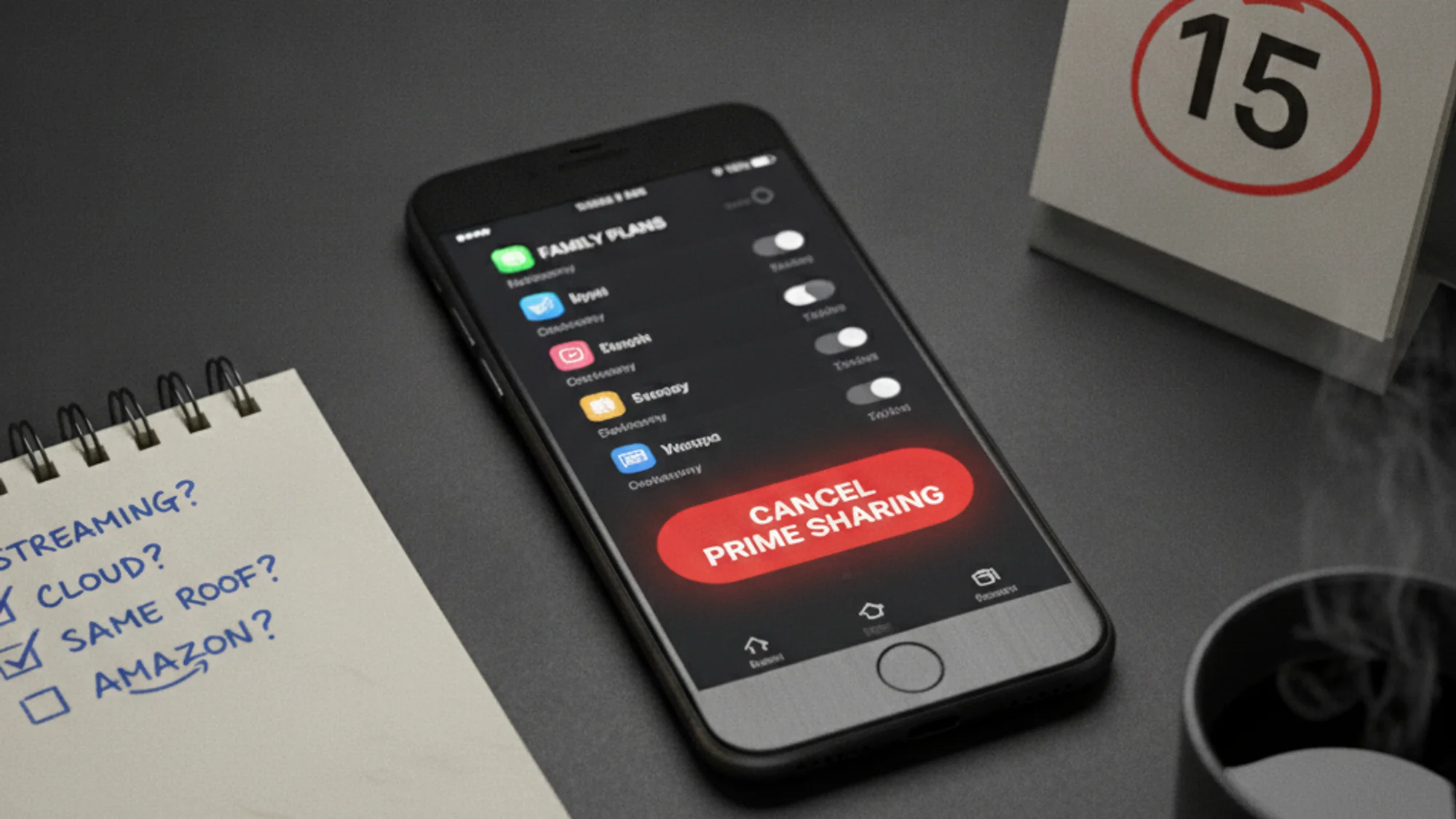
In late 2025, YouTube started sending out an email with a subject line that hit differently than most service updates: "Your YouTube Premium family membership will be paused." Thousands of people who had quietly been sharing a family plan with a sibling in a different city, or a parent two states over, got a 14-day countdown clock. Confirm you live together, or lose your benefits. No grace period beyond that.
I know people who scrambled at that point — not because they were doing anything shady, but because they genuinely had no idea the same-household rule was being enforced. They thought "family" meant family. It does, legally. Just not the family you imagined.
Quick answer
- No household requirement: Apple Family Sharing, Microsoft 365 Family, Dropbox Family, Google One (same country only)
- Same-address enforcement active: Spotify, YouTube Premium, Netflix (technically same household, Extra Member slots bypass this for one person at extra cost)
- Same-address enforcement active and tightening: Disney+, Max, Hulu
- Cross-household sharing eliminated entirely: Amazon Prime — the Invitee program ended October 1, 2025, with no paid add-on replacement
- Extra Member add-ons exist but cost extra: Netflix ($7.99–$9.99/mo), Disney+, Max ($7.99/mo), Hulu
The services that genuinely don't care where you live
The good news is more substantial than the streaming headlines suggest.
Microsoft 365 Family ($129.99/yr, up from $99.99 in February 2025) covers up to 6 people — the subscription owner plus 5 invited members. There is no same-household or same-country requirement documented anywhere in Microsoft's terms. Each member gets full Office apps and 1 TB of OneDrive storage. The one sting: Copilot in Word, Excel, and PowerPoint is reserved for the subscription owner only — members get zero AI features. Microsoft made this explicit in January 2025, and it generated a wave of angry forum posts from people who felt they'd been quietly shortchanged.
Dropbox Family ($16.99–$19.99/mo for up to 6 members) also has no household or country restriction. Each member keeps their own private account; there's a shared "Family Room" folder for anything you actually want to share. No GPS checks, no address verification, no enforcement emails.
Apple Family Sharing — and by extension Apple Music Family, Apple TV+, Apple One Family, and iCloud+ — requires that all Apple IDs be registered to the same country/region, but explicitly does not require members to live at the same address. That makes it one of the more relaxed sharing arrangements for families spread across a country. The organizer sets up the group and can manage child accounts and Screen Time; adult members are just members. Apple One Family ($25.95/mo) bundles Music, TV+, Arcade, and 200 GB of shared iCloud+ storage for all six people.
Google One is mostly permissive — same country, not same address — but requires at least the 100 GB plan; the 30 GB Lite tier disables family sharing entirely. Each member's Drive, Photos, and Gmail remain private; the shared pool only kicks in after they exhaust their personal free 15 GB.
The services enforcing same-household
Spotify Premium Family ($21.99/mo for up to 6 accounts) requires every member to enter the exact same home address as the plan manager when joining. Spotify does not track real-time GPS location — it checks the address you submit. But if Spotify can't confirm a member's address during a re-verification trigger, that member gets an email and 7 days to re-enter their address. Miss the deadline: lose access, plus a 12-month lockout from any Family or Duo plan. That's a punishing penalty for a software product.
YouTube Premium Family ($26.99/mo as of June 2026, up from $22.99 — a $4 hike announced April 10, 2026) uses an "electronic check-in" every 30 days via IP address and location data. The household enforcement email wave hit in late 2025, and the enforcement was uneven — some out-of-household members still had full access months after it began. The direction is clear, though. If you get the paused-membership email, you have 14 days; after that you remain in the family group but watch with ads.
Netflix is its own category. There's no family plan — never has been. Household sharing within the same address is included at no extra charge. Anyone outside your household gets an Extra Member slot: $7.99/mo with ads or $9.99/mo ad-free (these prices rose from $6.99/$8.99 in the March 2026 price hike). An Extra Member gets their own separate account, can stream from anywhere, but is limited to 1 device at a time, has no billing access, and is capped at 1 non-Kids profile. The account owner can swap which extra member is on the account up to twice a month.
Disney+ and Max have followed Netflix's playbook. Disney+ began rolling out Extra Member enforcement in September 2024; Max's CEO announced in August 2025 that messaging to out-of-household sharers would shift from soft notifications to required actions from September 2025 onwards. Max's Extra Member add-on is $7.99/mo — the added person gets their own account and password, accesses the same quality tier (4K on Premium), and streams on 1 device without affecting the primary account's concurrent stream limit.
Amazon: the one that just ended
Amazon's Prime Invitee program ended October 1, 2025, with no replacement. Amazon does not offer any paid "extra member" add-on for people living elsewhere — if you want to share Prime benefits, both adults must live at the same residential address. Former Invitees were offered $14.99 for their first year of their own Prime membership as a consolation.
Amazon Household still works for people who actually live together: two adults share Prime benefits — shipping, Prime Video, Prime Day deals — while keeping separate accounts and order histories. If one adult leaves, a 180-day lockout applies to both before either can join a new one.
What this means in practice
If your "family" is people who actually live with you, most of this is a non-issue — enforcement is aimed at the person who's had their college roommate on their Netflix for three years. Where it gets complicated is genuinely dispersed families: parents in a different city, adult kids who've moved out, relatives in another country. For those cases, the permissive options (Microsoft 365, Dropbox, Apple) carry real value — Apple One Family at $25.95/mo covers music, TV, and 200 GB of cloud storage for six people with no household check.
One practical habit that pays off: know what you're actually paying across shared subscriptions. If you're the plan manager on three services, you're carrying a meaningful slice of your family's entertainment bill — and it drifts up quietly between price hikes. Tracking shared costs in Subnesio makes it easier to judge when a family plan still earns its keep.
If a specific subscription is under review, deciding whether to pause or cancel is the right framing.
P.S. The Peacock and Paramount+ situation is the odd exception: both updated their ToS in 2024–2025 to restrict accounts to one household, but neither had implemented systematic enforcement as of mid-2025. If you're sharing either, the written terms don't permit it — but for now, nobody's stopping you. Enjoy the quiet while it lasts.