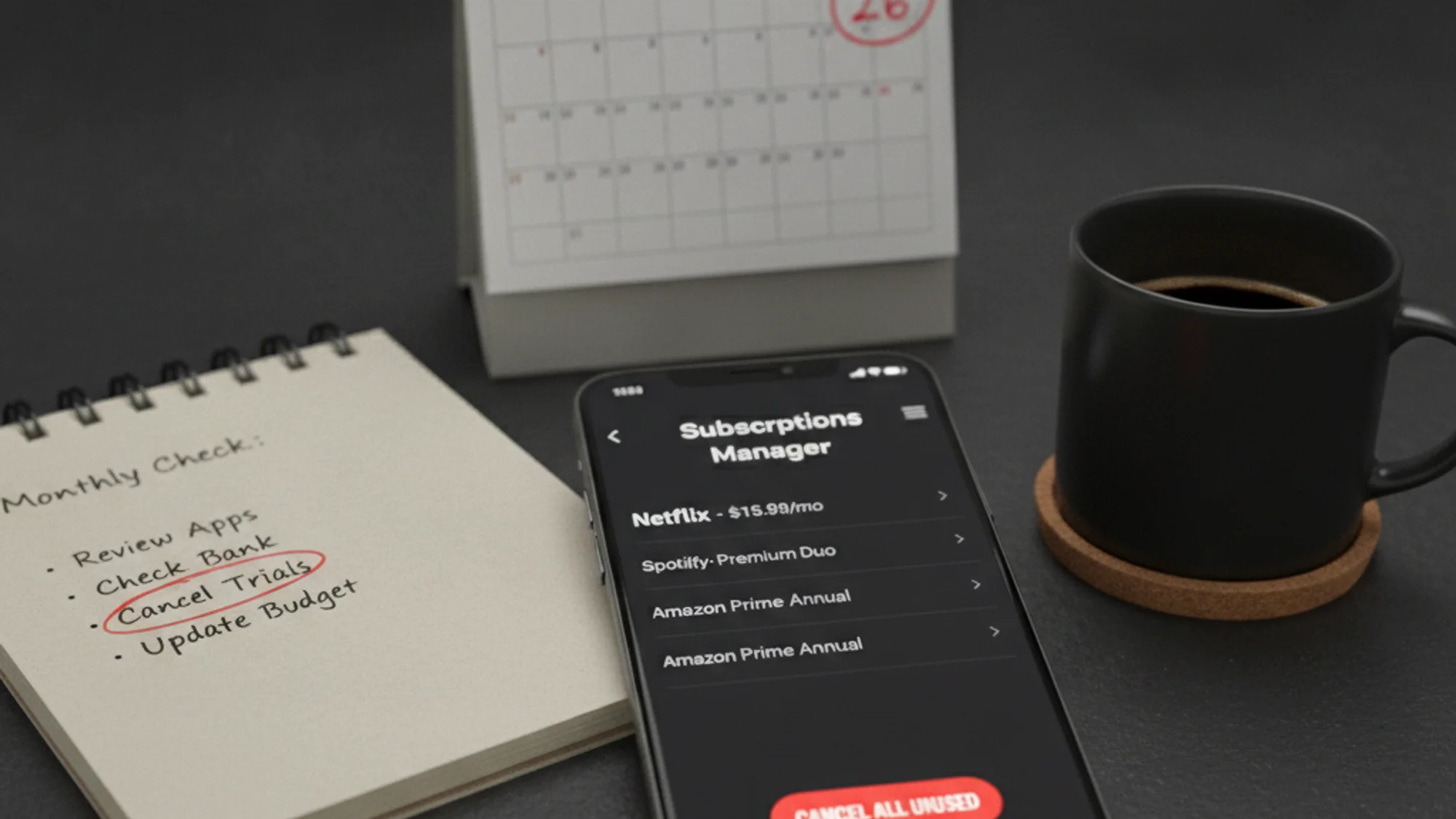
Netflix raised its Standard plan from $15.49 to $17.99 in January 2025 — no proactive email, just a higher number on the next billing statement — then did it again in March 2026, to $19.99. If you had a spreadsheet or a tracker and didn't open it for two months, you'd have been paying $4.50 more than your list said, silently, for weeks.
Quick answer
The monthly ritual takes about 15 minutes on the 1st of the month, before any bills actually post:
- Pull up last month's bank or card statement — look for any subscription charge that differs from your recorded amount.
- Check your inbox for "price change" or "billing update" subject lines from the past 30 days.
- Flip every free trial you started in the past month to either "cancel" or "keep" — no lingering.
- Log any new subscription you signed up for and forgot to add.
- Mark anything you haven't opened in 30 days and decide: pause, cancel, or conscious keep.
The goal isn't to re-audit from scratch — you already did that hard work. The goal is to keep the list you built from drifting into fiction.
Why lists go stale faster than you think
The problem isn't that people forget to track subscriptions when they start them — it's that the list becomes wrong over time without any action from you. A 2024 CNET Money survey found 67% of US adults saw at least one subscription price increase in the prior year; 73% of subscription businesses expected to raise prices in 2024, which makes price drift essentially guaranteed if you hold subscriptions long enough. Your list is accurate when you write it. By month three, it's probably off by $5–15.
The compounding part: services rarely raise prices by a $5 threshold (which is approximately the point where 61% of subscribers say they'd actually cancel). Netflix's March 2026 hike was $2. Spotify went from $10.99 to $11.99 in June 2024, then to $13 in January 2026 — each increment individually below the radar, collectively a 30% increase from $9.99 in 2023. Apple's App Store policy (since iOS 15.5) lets developers raise subscription prices automatically once per year without user consent, which means apps you haven't thought about in 18 months may already be billing higher than your list shows.
The 15-minute routine, step by step
Step 1: The statement scan (5 minutes). Open last month's credit card or bank statement — whichever card holds the most subscriptions. You're not looking for new charges from scratch; you're cross-referencing your existing list. Anything higher than your recorded amount is a price change; anything that appears and isn't on your list is a missed signup. If you use Subnesio, the amounts column serves as the comparison baseline — the question you're asking is whether the statement matches the tracker, not whether anything looks suspicious in isolation.
Telecom and cable are worth a second look here. Spectrum-style introductory rates typically expire after 12 months and automatically revert to full price — sometimes $20–30 more per month — without a separate notice. If you have any carrier or cable contract that's over 12 months old, check the line item.
Step 2: The inbox sweep (3 minutes). Search your email for "price", "billing", "rate change", "subscription update" in the past 30 days. Services are legally inconsistent about notification: California requires at least 15 days' notice before a price increase, New York 5–30 days — most other states have nothing. HBO Max gave 30 days' advance notice before its October 2025 price increase; Netflix didn't warn at all before January 2025. The inbox sweep catches the ones that did send a notice but got filtered into promotions.
Step 3: The trial audit (2 minutes). List every free trial you started in the past 30 days. A Self Financial survey from March 2026 found 70% of respondents had forgotten to cancel a free trial and been charged. Opt-out trials — where you hand over a card at signup — convert to paid at around 31%, versus 9% for opt-in trials. That 31% is almost entirely inertia, not satisfaction. Each trial on your list gets a decision today: cancel or keep. "I'll think about it" is precisely the mechanism that keeps the 70% number where it is.
Step 4: The status flip (3 minutes). Look at anything on your list you haven't used in the past 30 days. This step is about status, not about whether to cancel — just mark it. The Self Financial March 2026 data found an average of 2.6 unused subscriptions per person, at a combined cost of $26.79/month — but those people weren't ignoring their lists out of laziness; they just hadn't done a step-4 in a while. If you're uncertain about pause vs. cancel, the logic for that call is covered in the post on when to pause a subscription versus cancel it.
Step 5: New signups (2 minutes). Think back through the month — any free tier you upgraded, any annual renewal you let roll, any app where you hit a paywall and clicked "subscribe"? Add them. This is the step most people skip because new signups feel memorable. They're not, especially the ones that happened inside a larger purchase flow.
The list has no self-repair mechanism
A subscription list that you never open between audits is still better than nothing — but barely. Price changes don't write to your spreadsheet. Cancelled services don't remove themselves. A subscription you forgot to add doesn't appear. The list is a snapshot; without a sync operation, it ages quietly from the day you built it.
That's what the ritual is — a sync, not a fresh audit. Fifteen minutes to move the snapshot forward one month.
If you're still building that initial list — or want to think through how to structure it for tax purposes — how to organize subscription receipts for taxes and expense reports covers the category logic in more detail.
P.S. The best time to do this is before the 1st-of-month payments actually clear — that way you're comparing against the last cycle, not the current one that's still in flight.