Starting February 17, 2026, Chase stopped sending automatic notifications for recurring charges — online purchases, phone orders, and subscription renewals included. If you were relying on those alerts to catch an unexpected renewal, they're gone now; you have to configure a custom dollar-threshold alert to get anything at all.
That's a concrete reason to ask: how reliable was that detection in the first place?
Quick answer
Bank apps identify recurring charges using three methods: the recurring-payment indicator sent by the merchant's processor, the merchant category code (MCC), and transaction pattern-matching. Each of these has documented gaps. Annual subscriptions, PayPal-routed charges, and any service whose merchant name gets truncated can all fall through undetected — regardless of which bank you use. A dedicated tracker that you populate manually doesn't have these blind spots, because it tracks what you told it to track, not what the network happened to report.
What the bank actually sees (and what it doesn't)
When a subscription charge hits your card, the bank receives a data packet from the card network. Whether that packet identifies the transaction as recurring depends almost entirely on the merchant's processor. Mastercard made the recurring-payment indicator mandatory for all merchants in 2018 and tightened compliance again in July 2023 — but the mandate only works if the merchant's processor actually submits the field. A legacy integration or a non-compliant processor sends no recurring signal whatsoever. The bank sees a charge; it doesn't see a subscription.
Even when the indicator arrives, the bank still needs to correctly categorize the merchant. MCC 5968 ("Direct Marketing — Continuity/Subscription Merchant") is the primary subscription code, but streaming services, SaaS tools, and digital-content platforms often land under entirely different MCCs — and research from Tapix found that only 63% of transactions are correctly categorized by their MCC in the first place. One in three transactions is miscategorized before the bank's subscription logic ever runs.
The fallback is pattern-matching: look for charges at the same amount, from the same merchant, at regular intervals. Plaid's Recurring Transactions API — the engine behind many bank-linked tools — requires a minimum of three occurrences before flagging a stream as confirmed recurring. For monthly charges, that's three months. For annual subscriptions, three occurrences means three years of transaction history. An annual charge that renewed for the second time last month doesn't yet qualify as "recurring" under that model.
Then there's the review window problem. Most bank subscription views surface the past 30–90 days. An annual subscription that renewed eleven months ago is simply invisible — not because the detection failed, but because the bank isn't looking that far back. Chase's stored-card tool has a nine-month window; Citi's recurring-charges view doesn't publicly disclose its lookback at all.
The PayPal, Apple, and name-truncation problem
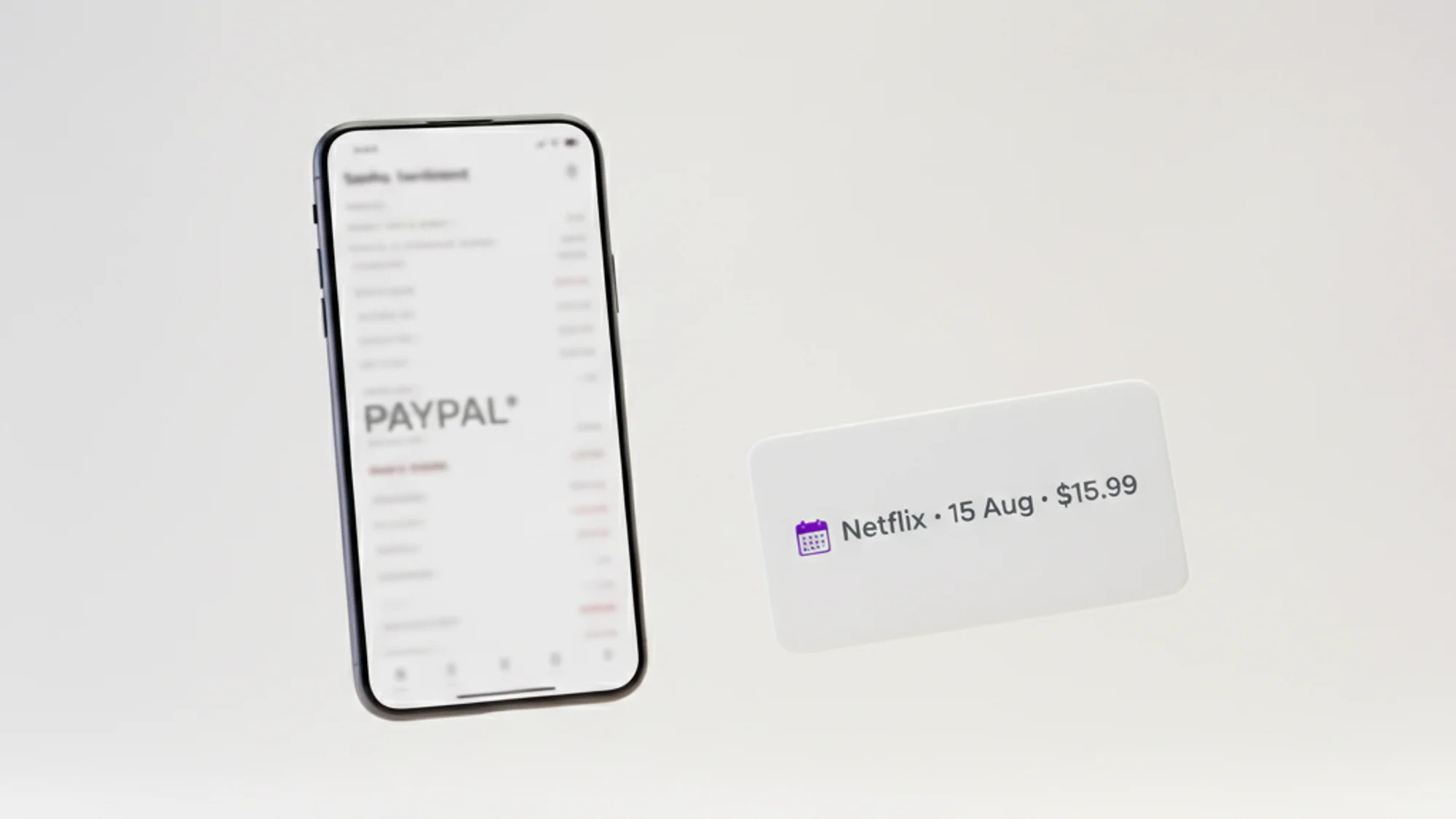
When you subscribe to something via PayPal, your bank statement shows a single "PAYPAL" transfer. The bank has no way of knowing which service it represents — or how many services are bundled into a single PayPal balance draw. Similarly, Apple consolidates every App Store purchase under APPLE.COM/BILL, with no indication of which app is billing. Google Play at least attempts to include the app name (GOOGLE*Developer), but Visa's 25-character and Mastercard's 22-character descriptor limits mean those names are routinely truncated or mangled before reaching your statement.
The downstream effect: Chargebacks911's 2025 Cardholder Dispute Index found that 40% of consumers often don't recognize purchases on their statement because of confusing or incomplete descriptors. That's not a niche problem — it's nearly half of cardholders.
If you're using a third-party tool connected to your bank via Plaid (like Rocket Money), you get the same transaction data the bank sees, run through the same pattern-matching limitations. If the bank misses it, the linked tool usually misses it too — with the added trade-off that you've shared your full banking history with a third-party aggregator to get incomplete results.
What a dedicated tracker actually catches
The difference between a bank's subscription detection and a tracker like Subnesio is the direction of knowledge. A bank tries to infer subscriptions from transaction patterns it observes. A manual tracker starts from what you already know — you enter the subscription, set the amount, set the billing cycle — and then tells you when it's coming up.
Annual subscriptions are first-class citizens from day one, not something the system needs three years to confirm. A PayPal-billed service you enter manually is tracked identically to a direct card charge. A truncated descriptor is irrelevant because you labeled the subscription yourself.
The limitation is the mirror image of the advantage: a manual tracker only knows about subscriptions you tell it about. If you want to find the ones you've forgotten, you still need to do a proper subscription audit — checking your PayPal "Manage Automatic Payments," Apple's reportaproblem.apple.com, and your full bank history going back at least 13 months to catch annual charges. Once you've done that audit once, a tracker keeps the list current without requiring the pattern-recognition gymnastics the bank goes through every time.
A 2022 C+R Research survey found that people's off-the-cuff estimate of their monthly subscription spend averaged $86, but the actual itemized total averaged $219 — a $133 gap. Some of that gap is deliberate forgetting. A lot of it is annual charges, intermediary billing, and truncated names that slipped past every detection layer, the bank's included.
Do the audit once. Then stop relying on pattern-matching.