My subscription bill was $247 last month. When a friend asked me to guess it off the top of my head, I said $90. That 2.7x gap is not a personal failing — it is the intended outcome of about four decades of pricing psychology research working exactly as designed.
Quick answer
Subscriptions feel cheap because three separate cognitive effects stack on each other: the left-digit effect makes $9.99 feel closer to $9 than to $10; the "pain of paying" effect makes a pre-paid subscription feel free each time you use it; and mental accounting makes small monthly buckets invisible against the size of your rent or salary. The result is a systematic underestimate — C+R Research found in 2022 that consumers estimated their monthly subscription spend at $86 on average, but the actual itemized total came out at $219.
The left-digit effect is not a rounding error
In 2005, Manoj Thomas and Vicki Morwitz published a study in the Journal of Consumer Research — now one of the most cited papers in pricing psychology — demonstrating through five experiments that the brain anchors on the leftmost digit of a price. When a price drops from $3.00 to $2.99, we don't process a one-cent reduction; we process a change from "three dollars" to "two dollars." The rightmost digits barely register.
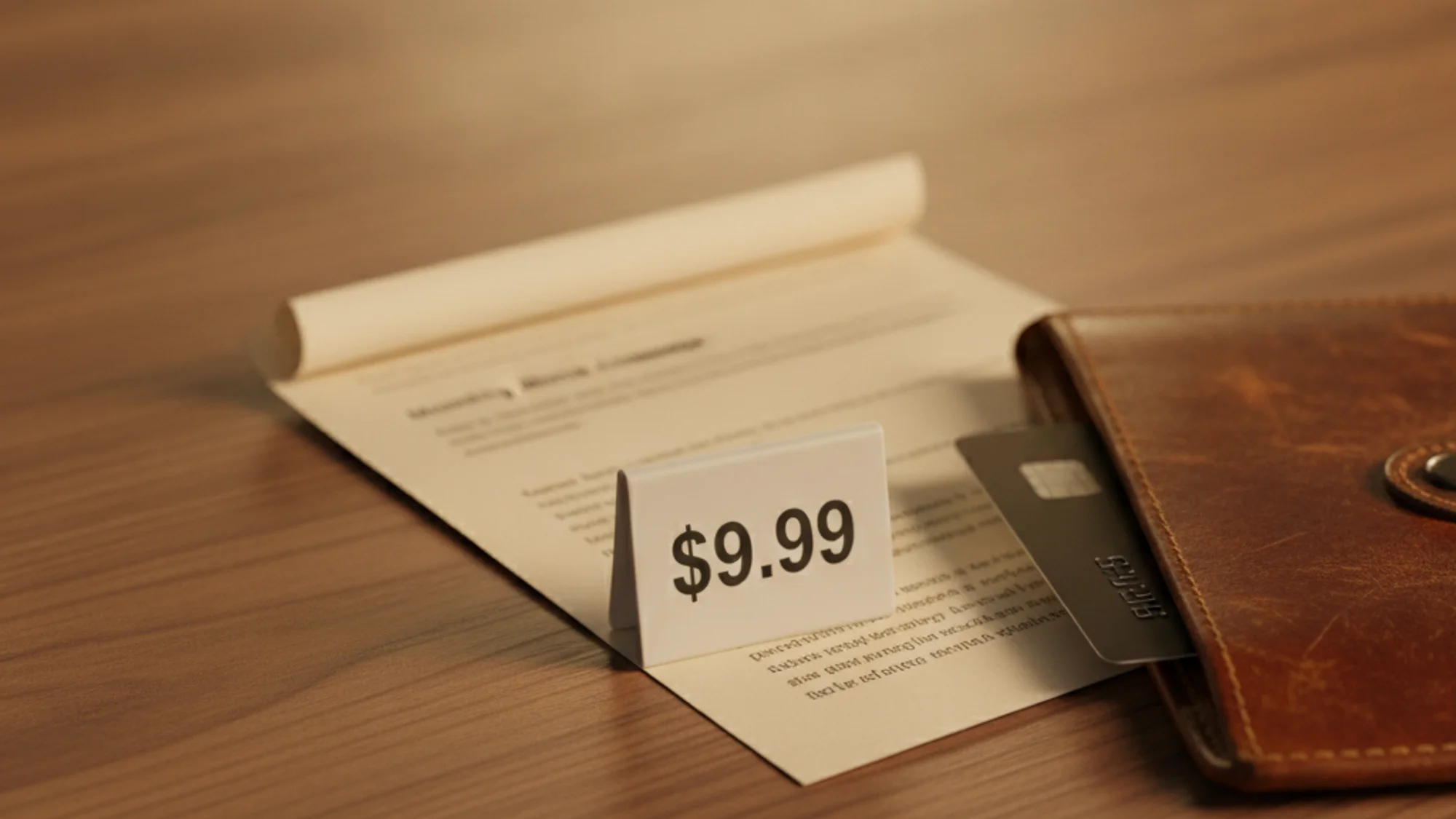
What makes this relevant to subscriptions specifically is how the effect compounds across tiers. A streaming service at $9.99 feels like it lives in the single-digit category. Bump it to $10.99 and it psychologically crosses into double digits. Eric Anderson and Duncan Simester ran a field experiment in 2003 that found dresses priced at $39 outsold the same dresses at $34 — a numerically lower price — by around 24%. The charm price pulled harder than the actual discount.
The left-digit effect only fires when the leading digit changes, which is why you'll almost never see a subscription priced at $10.59 dropped to $10.49. The company knows the drop from $10.99 to $9.99 is worth far more in perceived value than any equivalent cent reduction within the same leading digit.
Why recurring charges feel free after the first hit
Drazen Prelec and George Loewenstein named the "pain of paying" in a 1998 paper in Marketing Science — the idea that spending money triggers a mild aversive response, and that the timing and format of payment modulates how sharp that response is.
Their key finding for subscriptions: when you pay in advance and then consume later, the consumption feels free. The psychological account is already settled. Every time you open Netflix in month three of your subscription, your brain does not re-experience the $15.99 leaving your account — that event is in the past, categorized, closed. What you experience is free entertainment.
This is the opposite of what happens with a taxi meter running while you sit in traffic, or a pay-per-minute phone plan. Those formats force you to feel each unit of cost as it accrues. Subscriptions deliberately remove that signal.
Richard Thaler's mental accounting research adds another layer: people don't experience money as a single fungible pool. They allocate it into subjective mental buckets — groceries, rent, entertainment — and judge spending relative to the bucket's expected size, not relative to total income. A $13 streaming service goes into "entertainment," where it competes with a $15 cinema ticket once a month, not with the $800 in rent. Against that comparison, $13 is genuinely cheap. The problem is that every streaming service, every SaaS tool, and every "just $4.99 a month" app lands in the same bucket, and that bucket has no ceiling.
The decoy that moved 84% of buyers
Dan Ariely ran an experiment with 100 MIT students using a real Economist subscription offer: web-only at $59, print-only at $125, or print-and-web combined at $125. With all three options visible, 84% chose the combined plan. When the print-only option was removed, only 32% chose print-and-web. The print-only option was never purchased — it existed solely to make the combined plan feel like an obvious deal. That is textbook decoy pricing, first formally documented by Huber, Payne, and Puto in 1982: introducing an inferior option inflates willingness to pay for the target tier.
You see this pattern on every three-tier SaaS pricing page today — Basic / Pro / Enterprise, where the middle tier is designed to look like the rational choice compared to the stripped-down version below it and the expensive option above. The decoy is rarely labelled as such.
Flat-rate bias: why you'd pay more to pay less often
Anja Lambrecht and Bernd Skiera studied telecommunications customers in 2006 and found that consumers reliably chose flat-rate internet plans even when their actual usage patterns meant pay-per-use would have cost them less. They identified four drivers: people prefer the certainty of a known bill (insurance effect), they dislike the anxiety of watching units tick down (taximeter effect), they value not having to think about each use (convenience effect), and they overestimate how much they'll actually use a service.
That last one — the overestimation effect — is where the real money leaks. You subscribe to a language learning app imagining daily 20-minute sessions and get three sessions in January before the habit dies. The $14.99 keeps leaving your account because cancelling requires an active decision, and the app sits there as a low-grade reminder that you could use it. According to a Self Financial survey from March 2026, 59.9% of people are paying for at least one unused subscription, wasting an average of $26.79 per month.
What you can do in 30 seconds
The defence against pricing psychology is not willpower — it is deliberate friction at the decision point.
Open your last two bank and card statements and add up every line with a recurring amount. Not the total spend: just the recurring lines. Most people have never done this arithmetic in one sitting, which is why West Monroe's 2021 survey found that 89% of consumers underestimate their actual subscription spending, with 66% off by more than $200 per month.
Once you have the real number, three questions cut through the effects described above:
Would I pay for this again today if I had to actively re-subscribe? The pain-of-paying effect only works when payment is invisible. Making yourself re-answer the purchase question re-introduces the aversive signal the subscription model removes.
What is the annual cost? $9.99/month is $119.88/year. Writing the annual figure forces your brain out of the "small monthly bucket" frame and into a comparison set where $119 competes against other $119 purchases you make consciously.
Am I using this at the rate I imagined when I signed up? The flat-rate bias is driven partly by overestimation. Reality-checking your actual usage against the story you told yourself at signup is often enough to trigger a cancellation.
The monthly subscription audit ritual — doing this once at the start of each month — takes less than five minutes once you have a list. For keeping that list without connecting a bank account, here are the best subscription trackers that work without bank access.
I still guessed $90 even though I know this research — which tells you that knowing these mechanisms doesn't immunize you against them. What does help is a system that makes the actual number visible before the renewal arrives, not after. If you want one place to see everything before it charges, Subnesio's pricing page is here.
P.S. The ICPEN sweep of 642 subscription sites in 2024 found that 81% made it impossible to turn off auto-renewal during sign-up. The design of the checkout is not neutral — it is part of the same playbook as the $9.99 price tag.