Quick rule: is a bundle worth it?
A bundle is worth it only if the services you actively use cost more separately than the bundle price.
- Count only services you use every month.
- Ignore "maybe useful later" apps.
- Compare against cheaper individual plans.
- Recheck after price changes.
- Cancel or downgrade if one core service stops being useful.
How to audit a bundled subscription
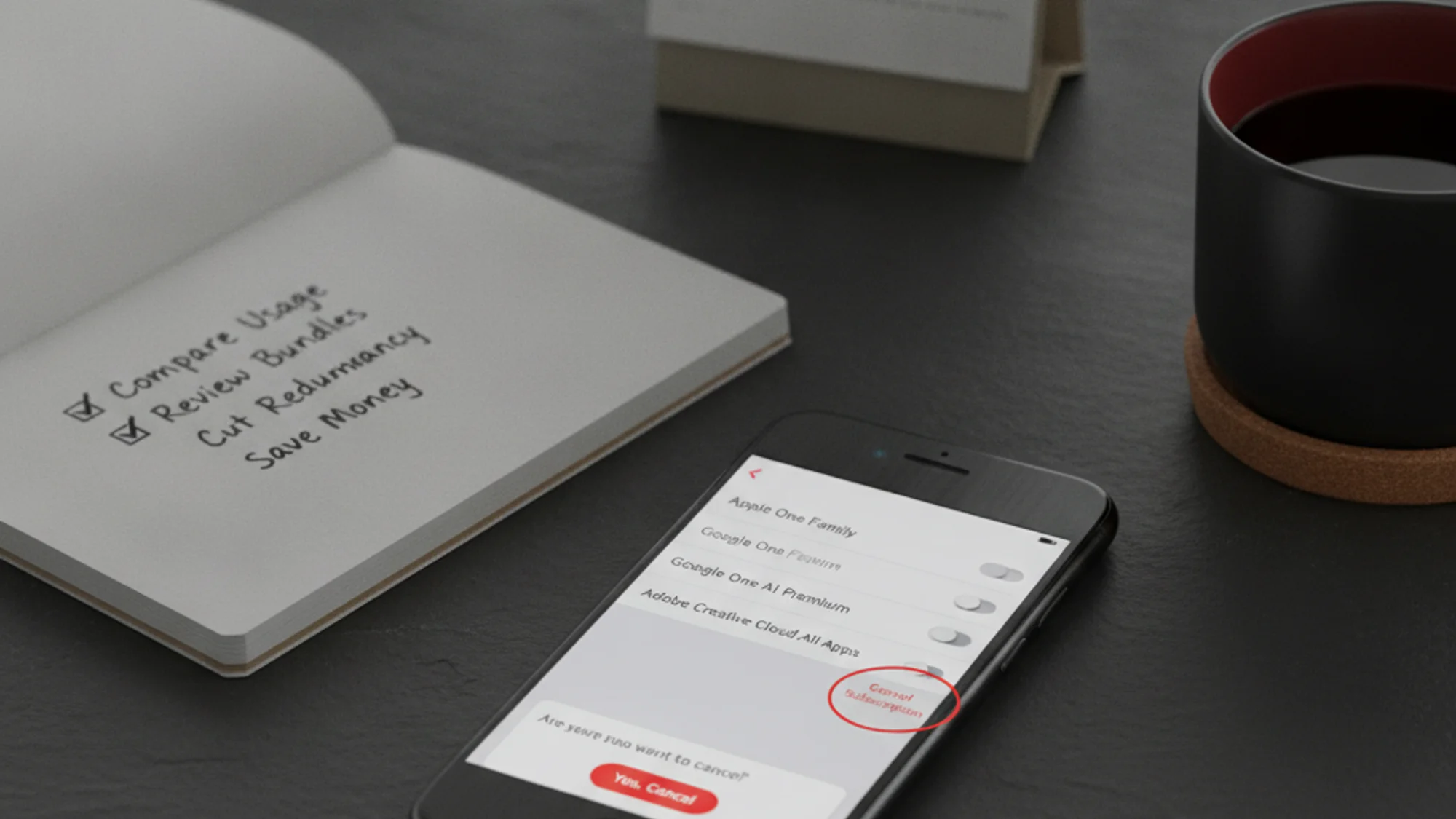
- Write down the bundle price.
- List every included app or service.
- Mark what you used in the last 30 days.
- Price only those services separately.
- Cancel or downgrade if the bundle no longer wins.
A reader emailed me last month: "I switched to Apple One Premier to save money, and a year later I realised I only use Apple Music and 200GB of iCloud. Did the bundle actually save me anything?" The honest answer is no — and the same trap is wired into Google One AI Premium and the new Adobe Creative Cloud Pro. Bundles are priced against a fantasy version of you who opens every component. Most of us are not that person.
The Apple One math everyone quotes — and what it hides
Apple's own pitch for Apple One Premier rests on one number: $37.95/month for six services that cost $63.94/month standalone. The gap looks decisive until you ask which of the six you actually open.
| Component | Standalone price |
|---|---|
| Apple Music | $10.99 |
| Apple TV+ | $12.99 |
| Apple Arcade | $6.99 |
| Apple News+ | $12.99 |
| Apple Fitness+ | $9.99 |
| 2TB iCloud+ | $9.99 |
| Sum | $63.94 |
| Apple One Premier | $37.95 |
The bundle wins by ~$26/month if you use all six. Drop Apple News+ and Fitness+ — the two most commonly ignored — and your real standalone basket is $41.96. The bundle still saves you four bucks, but the headline "save $26" has quietly become "save $4". Drop Apple TV+ too, because you already pay for Netflix, and standalone falls to $28.97 — at which point the bundle is charging you $9/month for the privilege of being bundled.
Apple One Individual has the same shape. Standalone components total $31.96 (Music $10.99 + TV+ $12.99 + Arcade $6.99 + 50GB iCloud+ $0.99) versus $19.95 bundled — but a user who only watches Apple TV+ and pays $2.99 for 200GB iCloud+ sits at $15.98/month. The "Individual" bundle is $4 more expensive for that person, not cheaper.
There's a structural reason the gap keeps widening in Apple's favour on paper. When Apple raised Apple TV+ standalone in 2023 and again in 2025, Apple One subscribers paid the same. The "savings" number gets bigger every time a component's standalone price goes up — without Apple shipping anything new. That's the bundler's lever, not a discount.
Google One AI Premium: a $10 storage plan with a $10 chatbot tax
Google One's 2TB Premium plan is $9.99/month. Google One AI Premium is $19.99/month and bolts on Gemini Advanced, Deep Research, and Gemini in Gmail and Docs. The arithmetic is brutal — if you don't actually open Gemini, you are paying $10/month — $120/year — for a feature you ignore, dressed up as a storage upgrade. In January 2026 Google launched a $7.99 Google AI Plus tier in the US, which only sharpens the question: why is the headline plan $20 if a thinner Gemini ships for $8?
Adobe Creative Cloud Pro vs Photography: the bundle you didn't need
In June 2025 Adobe retired the $59.99 Creative Cloud All Apps plan and rolled everyone onto Creative Cloud Pro at $69.99/month — $120/year more for the same software footprint plus AI credits most subscribers never asked for. If you actually live inside Premiere, After Effects, Illustrator, InDesign and a dozen other apps, fine. If you only need Lightroom and Photoshop, the Adobe Photography 20GB plan is still $9.99/month — one seventh the price. That's not a rounding error; that's a $720/year mistake hiding inside the default checkout flow.
The same Adobe was sued by the FTC in 2024 over hidden early-termination fees and an obstructed cancellation path. A vendor that makes it hard to leave has every reason to keep you on the bigger bundle.
The rule I now use before renewing any bundle
Before I let any bundle auto-renew, I ask three questions, in this order:
- Which components did I open at least once this month?
- What would those components cost standalone today (not at last year's prices)?
- Does the bundle still win by at least 15% after I strip out what I don't use?
If the answer to the third question is no, the bundle is a habit, not a saving. Most readers think they're saving more than they are — C+R Research found people guess their monthly subscription spend at $86 while actually paying $219, a 2.5x undercount. JD Power put the average US streaming bill alone at $73.47 in January 2025. Bundles are a big part of why the gap is that wide: one $37.95 charge feels like a single decision, even when it's six.
If you can see at a glance that Apple News+ hasn't been opened in 90 days, the bundle math stops being abstract. There's more on the same idea in the true cost of forgotten subscriptions, a practical walkthrough in how to track all subscriptions, the Apple One cancellation and downgrade guide, and — if the goal is a monthly ceiling — how to set a hard cap on recurring spend. For why your bank app won't catch this for you, see why your bank subscription tracker is not enough.
P.S. If your Apple One bill renews tomorrow, open the Music, TV+, Arcade, News+, Fitness+, and iCloud apps right now and count which ones you've actually launched this week. That number, multiplied by the standalone price, is what you should be paying.
For a single view of every bundle and its renewal date, Subnesio is one option — see Subnesio pricing.